×
-
 Email Address
info@kidzkourtroom.com
Email Address
info@kidzkourtroom.com
Email Address
info@kidzkourtroom.com



Somewhere in a school right now, a 10-year-old stands up, looks at two classmates who are in conflict, and tells them:
That is KidzKourtRoom™.
KidzKourtRoom™ ignites the leadership spark in young people ages 8 to 14. Through guided practice with fictional cases, rotating leadership roles, and a structured deliberative process, students build empathy, accountability, and shared decision-making before those skills are ever tested in real life.
Grounded in restorative justice and the Early Ethical Leadership Method℠ (EELM℠), developed in Raleigh, NC. For schools, churches, and youth organizations. In English and in Spanish.
Request the Free EELM℠ Basic Guide Explore the KidzKourtRoom™ Universe

KidzKourtRoom™ (KKR) is a structured, student-led leadership development program for grades 3 through 8 — ages 8 to 14. It gives young people a safe, guided space to practice the habits of ethical leadership — listening without interrupting, reasoning without assuming, building consensus, taking responsibility for outcomes — through a progressive sequence of ten professionally crafted fictional cases that grow in complexity as students grow in skill.
In each session, students rotate through five defined leadership roles, assigned by random draw — the Magic Hat. They deliberate together on a fictional scenario, represent every perspective in the case, and work as a team toward a conclusion. No real student conflict is ever discussed, and the sessions themselves collect no personal information about any participant.
The EELM℠ framework grows from the narrative foundation established in the novel KidzKourtRoom: El Tribunal de los Sueños by Marlon Gavironda — available now on Amazon (Kindle & Paperback). The novel introduces the five characters, the five leadership roles, the five virtues, the symbols, and the ethical language that give the method its shared vocabulary. Guided engagement with the novel is therefore part of Silent Ally formation and helps preserve consistency between the storyworld and the educational practice.
The outcome: students who have practiced ethical leadership — not just read about it.
Request School Pilot Information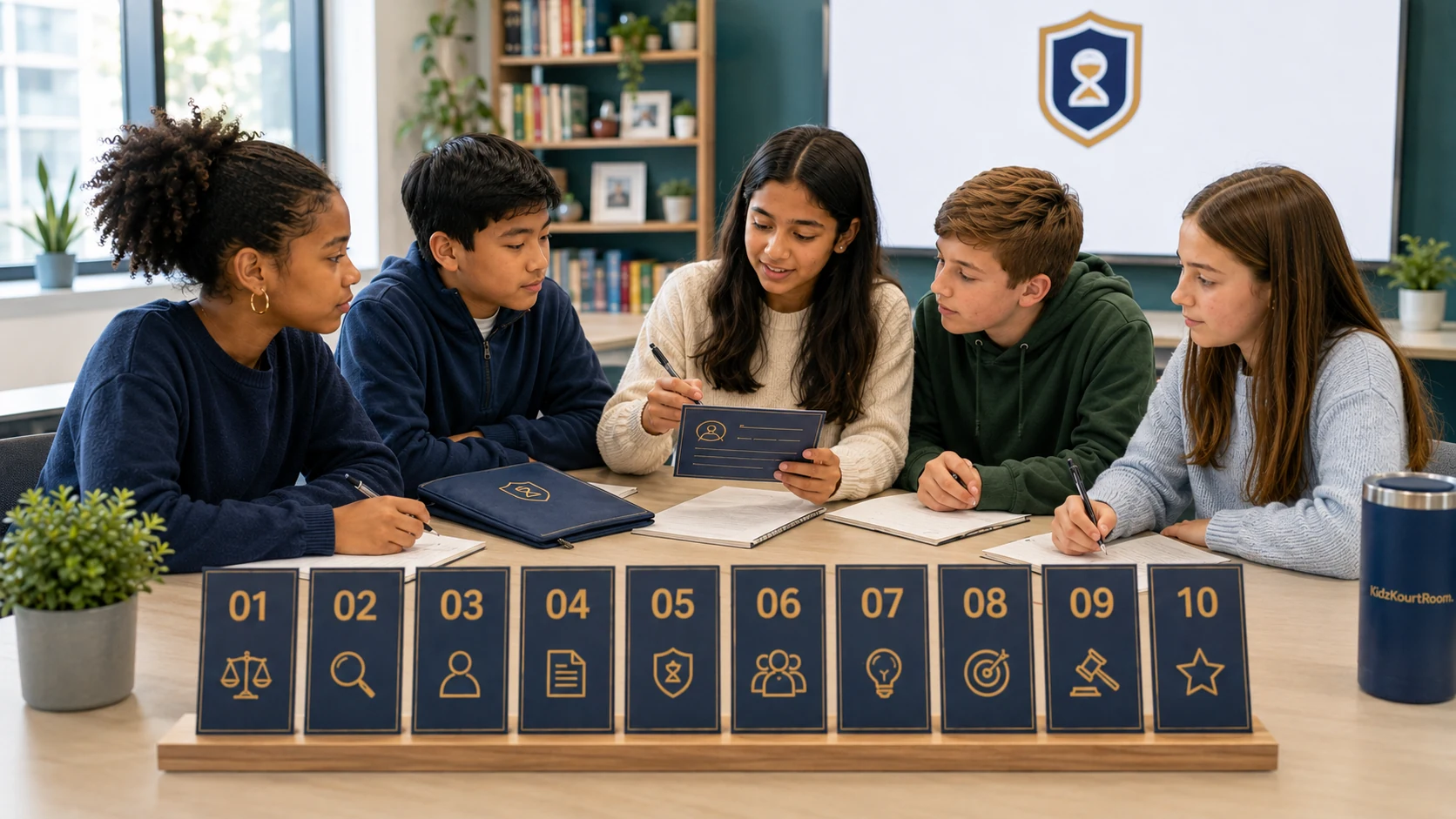
A child who rotates through five leadership roles across ten fictional cases is doing more than playing a game.
They are building a habit of mind — the habit of hearing before judging, of separating what they observed from what they assumed, of looking for solutions rather than winners.
That habit — practiced at ages 8 to 14, before real stakes, in a safe and structured environment — is what KidzKourtRoom™ calls the leadership spark.
We don’t teach leadership. We create the conditions in which it ignites.
Level 1 — Formation, Training & Practice
What we offer today. For schools, churches, and youth organizations serving students in grades 3 through 8 — ages 8 to 14.
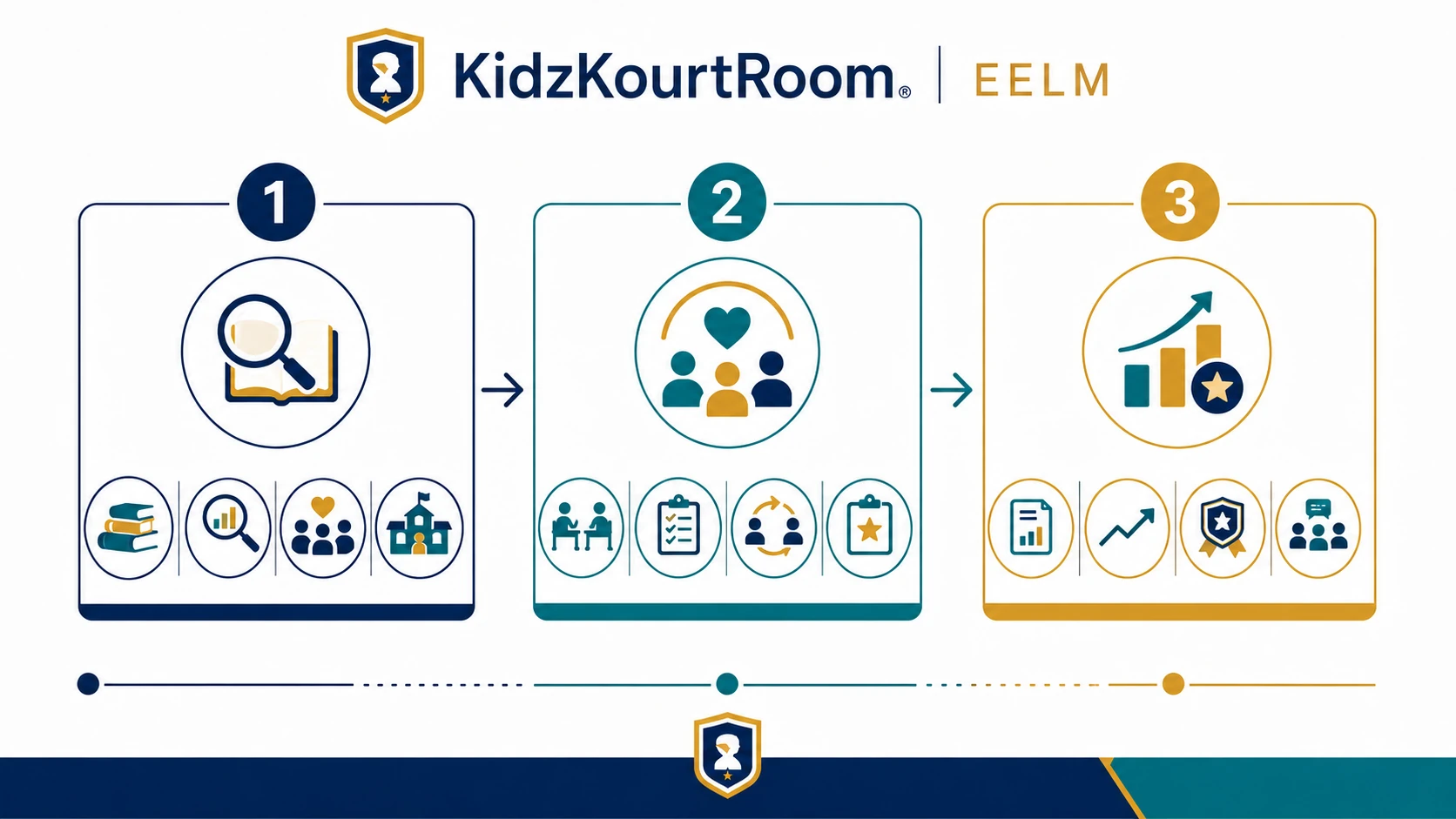
Level 1 moves in three steps that cannot be skipped or reversed:
Step 1 — Silent Ally Formation
Before any student enters a session, the adults do. Every educator, youth minister, counselor, or staff member who will support the program completes the 25-hour Silent Ally formation process. Formation begins with guided reading and discussion of KidzKourtRoom: El Tribunal de los Sueños, the narrative foundation of the EELM℠ framework, and continues through restorative justice principles, social-emotional learning, ethical facilitation, youth development, and EELM℠ safety protocols. Silent Allies are trained in one essential discipline — how to be fully present without directing. They observe, support, and intervene only when safety or ethics require it. They never decide outcomes. The students do.
Step 2 — Student Training
Once Silent Allies are certified by KidzKourtRoom/EELM℠, students begin their own formation. They learn the EELM℠ framework: the five leadership roles, the five-step deliberation structure, the Oath of the Feathers℠, and the ethical principles that guide every session. They practice the mechanics of the process before working through the fictional case sequence.
Step 3 — Practice Through 10 Progressive Fictional Cases
Students in grades 3 through 8 — ages 8 to 14 — work through a sequence of ten professionally crafted fictional cases, designed and approved by KidzKourtRoom™, that increase progressively in emotional complexity and ethical depth. These cases involve fictional characters in fictional situations. No real student conflict is ever discussed, and the sessions themselves collect no personal information about any participant.
Roles are assigned by random draw each session — the Magic Hat — so that every student, across the full program year, practices every dimension of ethical leadership. The five roles are:
1. Justice Guardian
Opens each session. Ensures that every perspective in the fictional case is heard with equal weight. Announces the group’s conclusion.
2. Clue Explorer
Presents only what is observable and verifiable in the fictional scenario. Keeps the group grounded in evidence, not assumption or emotion.
3. Restorative Facilitator
Holds equal attention for every perspective in the fictional situation. Listens with empathy, does not take sides, and helps the group remain oriented toward understanding and repair without imposing a resolution.
4. Social Spark
Observes the group’s dynamic. At the right moment, offers a creative path that no one else had considered.
5. Chronicler
Records the group’s reasoning and conclusions in clear, neutral language. Reads the record aloud before the session closes.
In each session, roles rotate by the Magic Hat. Every student practices every role over the course of the program. Progress is tracked using the Five Virtues Performance Rubric — an observation instrument still in development and validation. Students who complete the full sequence earn the EELM℠ Level 1 Credential — an internally issued, verifiable credential from KidzKourtRoom Entertainment, Inc. under the EELM℠ framework.
Level 2 — Future Development
Not currently offered. Everything available today is Level 1, based exclusively on pre-written fictional cases and no real student conflicts.
What Students Carry Forward
Through repeated practice — with fictional cases, rotating roles, and real deliberation under guidance — students get to exercise skills across all five areas CASEL describes: self-awareness, self-management, social awareness, relationship skills, and responsible decision-making.
What cannot be instructed but must be practiced: the confidence to listen before reacting, the discipline to separate what you observed from what you assumed, and the civic habit of looking for repair before assigning blame.
That is the leadership spark KidzKourtRoom™ ignites — one session, one role, one case at a time.
Request the Free EELM℠ Basic GuideLeadership is not built by hearing about it. It is built by doing it. The EELM℠ is designed around that premise: it gives students repeated, structured opportunities to lead — not a passive exercise, not a worksheet, but a real deliberative process with real roles and real responsibilities, practiced safely through fiction before those skills are needed in real life.
The EELM℠ is informed by established bodies of research in restorative practices and social-emotional learning in K–12 education. Restorative justice programs are associated with reduced out-of-school suspensions and improved school climate, though the size of the effect varies across studies and contexts (Gregory et al., 2016; Anyon et al., 2016). A randomized trial in Pittsburgh found improvements in school climate and reductions in suspensions, though it did not improve overall academic outcomes during the period studied (Augustine et al., 2018); we say so because being honest about what the evidence does and does not show is part of our method. Social-emotional learning programs produce, on average, an 11-percentile-point gain in academic achievement, along with improvements in behavior and reductions in conduct problems, with benefits that also persist at follow-up (Durlak et al., 2011; Taylor et al., 2017).
This is the kind of impact the EELM℠ is designed to work toward — not to claim. It is an original method, and its specific efficacy has not yet been established: it must be evaluated on its own.
KidzKourtRoom™ is in its pilot-development phase. We are building our own evidence base — session by session, case by case — and we intend to publish what the data shows, including what it does not yet show.
Programs that overclaim early lose credibility permanently. We intend to earn ours.
Buy Book on Amazon
Planned apparel, accessories, a Pippin plush and symbolic program pieces extend the KidzKourtRoom universe into tangible brand experiences.


You are measured by school climate, disciplinary data, and student outcomes. Those are precisely the areas the EELM℠ Level 1 Pilot is designed to examine — for students in grades 3 through 8. The Level 1 model is designed to work within existing school staffing structures rather than requiring a dedicated new program role. A counselor, restorative-practice coordinator, or trained classroom teacher can serve as a Silent Ally once certified by KidzKourtRoom/EELM℠. All sessions use fictional cases: no real student conflict is discussed, and the sessions collect no personal information. Where a pilot site chooses to measure outcomes, any assessment is administered by the participating institution under its own data-governance procedures and applicable privacy obligations, including FERPA where applicable. KidzKourtRoom receives only aggregated or de-identified results — never identifiable student records. Because your legal counsel will ask, the design is intended to simplify that review.
You know the conflicts that never get resolved. The rumor that fractured a friend group. The exclusion that shows up as classroom avoidance. The hurt that suspension makes worse. As a Silent Ally certified by KidzKourtRoom/EELM℠, you don’t run the session. You hold the conditions for student leadership to be safe. The 25-hour formation program prepares you for exactly that — how to be fully present without directing, how to intervene only when it matters, and how to watch students ages 8 to 14 discover that they can lead responsibly within a structured process.
Your child will face hard moments — in friendships, in classrooms, in every relationship they build as they grow. KidzKourtRoom™ gives them the practiced experience of standing in the middle of a difficult fictional situation, listening to different perspectives, and working toward something fair — before those skills are tested in real life. The goal is to let those habits become familiar before young people need them in situations that truly matter.
KidzKourtRoom™ is a trademark with a U.S. application pending, a published novel that serves as the narrative foundation of the EELM℠ framework, WGA-registered television scripts, a comprehensive bilingual program documentation system, and a QR-enabled credential verification system in development. Institutional conversations for prospective Level 1 pilots are underway in North Carolina, Latin America, and Spain; no pilot cohort is currently in operation. KidzKourtRoom is also a transmedia universe: educational practice, animated series, games, a planned digital platform, and the planned Truth Flies Free Foundation — all anchored in the same narrative and ethical foundation. If you build content for young audiences, invest in education, or recognize a story with room to grow, this is worth a conversation.
For Schools: Request Pilot Info For Parents: Get First Chapters For Partners: Explore Opportunities

KidzKourtRoom™ is in its pilot-development phase. The most credible thing we can tell you is exactly where we are and exactly what we are working toward.
What the research on comparable approaches shows:
Restorative justice programs are associated with reduced out-of-school suspensions and improved school climate, though results vary across studies and contexts (Gregory et al., 2016; Anyon et al., 2016). Social-emotional learning programs produce, on average, an 11-percentile-point gain in academic achievement, along with reductions in conduct problems, when fidelity is maintained (Durlak et al., 2011). This is the kind of contribution the EELM℠ is designed to work toward — not to claim as its own result before it has been evaluated. The EELM℠ is informed by this evidence, but its specific efficacy has not yet been established: it is an original method that must be evaluated on its own. Likewise, we chose the 8-to-14 age range as a developmentally grounded pedagogical decision — a stage of significant change in reasoning, emotional regulation, and social cognition (Dahl et al., 2018) — not as a claim about an exclusive “brain window.”
What the EELM℠ Level 1 Pilot is designed to measure:
How participant privacy is protected:
The sessions collect no personal data. Where a pilot site measures outcomes, any assessment is administered by the participating institution under its own data-governance procedures and applicable privacy obligations, including FERPA where applicable. KidzKourtRoom receives only aggregated or de-identified results — never identifiable student records.
What we intend to publish:
A plain-language evidence report for each completed Level 1 pilot site describing what the data shows, what it does not yet show, and what would be required to support stronger claims.
Programs that overclaim early lose credibility permanently. We intend to earn ours.
Explore the story and the thinking behind KidzKourtRoom™. Download our materials — no sign-up required.
Neither does leadership. Start where you are. Start with practice.
Tell us who you are and what you need. We typically respond within two business days, in English or Spanish.
KidzKourtRoom™ and the Early Ethical Leadership Method℠ (EELM℠) are original educational programs informed by widely recognized pedagogical and restorative principles. Montessori®, the Association Montessori Internationale (AMI), the American Montessori Society (AMS), and related marks belong to their respective owners. KidzKourtRoom™ and the EELM℠ are not affiliated with, accredited by, certified by, sponsored by, authorized by, or endorsed by AMI, AMS, any Montessori organization, CASEL, Howard Zehr, or any of the authors, institutions, or programs referenced, and do not form part of them. All such references — including Montessori, CASEL, restorative justice, and cited authors — are made solely for educational, comparative, and academic purposes as widely recognized and publicly described reference systems and frameworks, and imply no affiliation, endorsement, or sponsorship of any kind.
During the Level 1 Pilot, sessions use exclusively pre-written fictional cases; no real student conflict is discussed and no personal data is collected within the sessions. Where a pilot site measures outcomes, any assessment is administered by the participating institution under its own data-governance procedures and applicable privacy obligations, including FERPA where applicable, and KidzKourtRoom receives only aggregated or de-identified results — never identifiable student records. Results may vary depending on participation levels, institutional implementation, and the context of each group. This program does not replace school, therapeutic, legal, pastoral, or child-protection protocols. In any serious or sensitive situation, established formal procedures must always be followed.
EspañolKidzKourtRoom™ y el Método Ético de Liderazgo Temprano℠ (EELM℠) son programas educativos originales informados por principios pedagógicos y restaurativos ampliamente reconocidos. Montessori®, la Association Montessori Internationale (AMI), la American Montessori Society (AMS) y las marcas relacionadas pertenecen a sus respectivos titulares. KidzKourtRoom™ y el EELM℠ no están afiliados, acreditados, certificados, patrocinados, autorizados ni respaldados por AMI, AMS, ninguna organización Montessori, CASEL, Howard Zehr ni por ninguno de los autores, instituciones o programas citados, y no forman parte de ellos. Todas esas menciones —incluidas Montessori, CASEL, la justicia restaurativa y los autores citados— se realizan exclusivamente con fines educativos, comparativos y académicos, como sistemas y marcos de referencia ampliamente reconocidos y descritos públicamente, y no implican afiliación, respaldo ni patrocinio de ningún tipo.
Durante el Piloto de Nivel 1, las sesiones utilizan exclusivamente casos ficticios preelaborados; no se discute ningún conflicto real de estudiantes y no se recopilan datos personales dentro de las sesiones. Cuando un sitio piloto mide resultados, cualquier evaluación la administra la institución participante conforme a sus propios procedimientos de gobernanza de datos y a las obligaciones de privacidad aplicables, incluida FERPA cuando corresponda, y KidzKourtRoom recibe únicamente resultados agregados o desidentificados —nunca registros identificables de estudiantes—. Los resultados pueden variar según el nivel de participación, la implementación institucional y el contexto de cada grupo. Este programa no sustituye protocolos escolares, terapéuticos, legales, pastorales ni de protección infantil. Ante cualquier situación grave o sensible, deben seguirse siempre los procedimientos formales correspondientes.